Positions:
- Copy Editor (Spring 2022)
- Chief Copy Editor (Fall 2022)
- Content Editor (Spring 2023-Fall 2024)
What I did:
Redesigning the Website

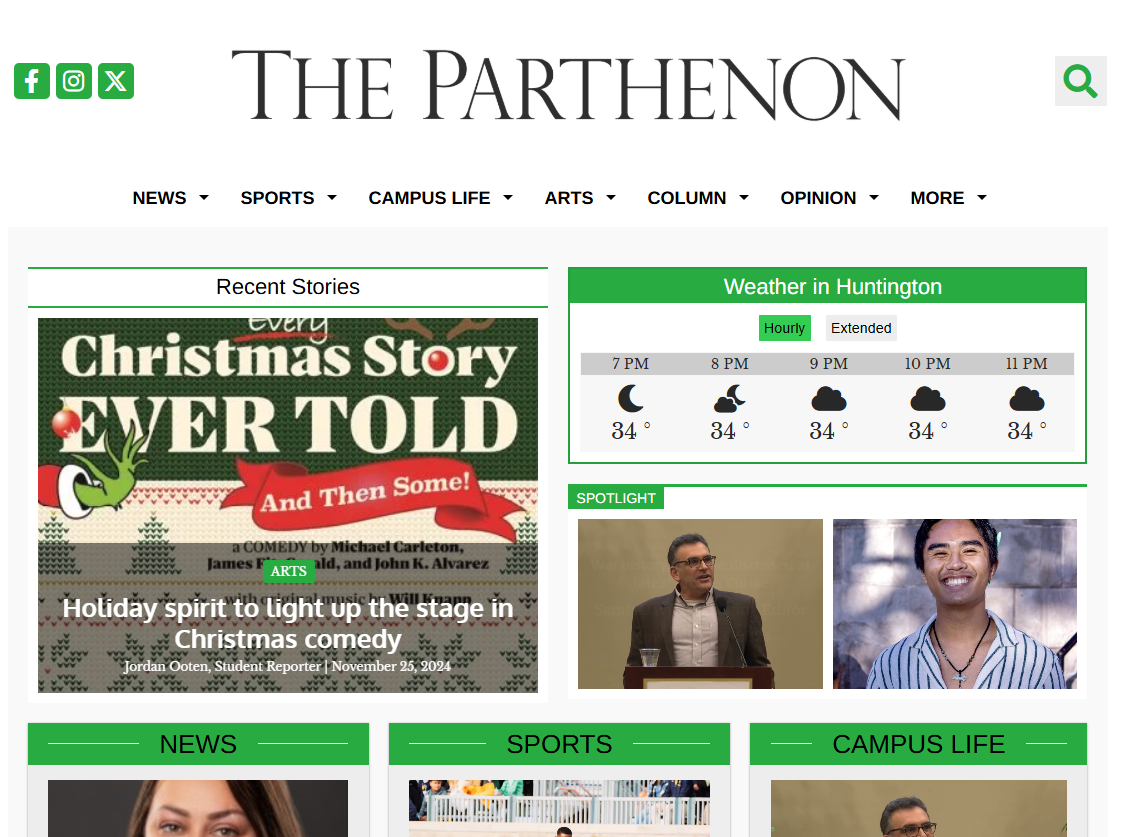
Drag the button in the middle of the image above to compare the two homepages
(left = before 2023 redesign; right = final state in 2024)
When I became Content Editor in 2023, I absorbed the responsibilities of a webmaster alongside my original copy editing duties. Consequently, I completely redesigned the site to improve its navigability and make its overall appearance more uniform. I standarized the columns on the homepage displaying stories under different news categories to be the same size and to display the same number of stories. I also created the “Spotlight” area at the top to better highlight those stories the staff designated as important or breaking. Additionally, I updated all of the site’s menus, which were originally so outdated that they completely lacked links to the Arts category. These changes came alongside various aesthetic changes, like making the shade of green more uniform and adding a weather widget.
I also improved the site’s organization by reorganizing its internal categorization system. The site allows editor to tag stories based on various categories like “Sports,” “Arts,” “News,” “Campus Life,” etc. These categories affected how a story appeared on the homepage and how easy they were to find; however, how a story was categorized varied based on who uploaded the story. After deleting and consolidating various outdated categories, I instituted a policy that limited most stories to 3 categories, which kept their organization consistent and prevented one story from appearing multiple times on the homepage under different categories.
Site Traffic & Workflow Optimization
As Content Editor, I spent hours poring over site analytics–everything from click-through rates to average readership per category–to broaden The Parthenon’s digital presence. In the fall of 2024, after receiving some SEO training through my web development internship, I also led the editing staff in implementing several SEO optimization strategies: internal linking to similar and related stories; generating optimally long meta descriptions; including key words in headlines like an event’s title or a person’s name; and more. Additionally, I created an upload schedule that ensured a story went online every day while also ensuring that higher profile stories (like those about sports and campus-related events) went up on days that would maximize potential traffic.
I also programmed a Google Sheet using Google Apps Script that improved the newspaper’s system for tracking articles’ progress through the writing process. The “Master Calendar,” as the staff called it, tracked everything from headlines, bylines, photo credits, event dates, editing progress, and more. It could create Google Calendar reminders for story uploads to coordinate between reporters, editors, and photographers–all while making sure stories were written and posted to the website on time. Custom sorting functions also shortened the time spent finding stories from minutes to seconds by organizing the sheet based on editing status, original event date, and upload date. The Parthenon continued using a version of the Master Calendar even after I left at the end of 2024.
Growing the Copy Editing Team
When I started in the spring of 2022, I copy edited every story The Parthenon published physically and digitally because I was the only copy editor. That averaged to about 10 stories every week (which is still the average number of stories the paper publishes every week during the school year). I did all this while also learning AP Style and newswriting on the job because I was a computer science and creative writing double major with 0 prior journalistic experience.
Eventually, though, I grew the copy editing team to a handful of dedicated editors all either directly trained by me or someone whom I’d trained myself. We comprised the most interdisciplinary facet of the editorial staff at The Parthenon, as most of us were not journalism majors at Marshall; however, even the journalism professors recognized that we knew the AP stylebook inside and out.
When I wasn’t editing or webmaster-ing, I also wrote a handful of stories for The Parthenon as well. Please enjoy a selection of some of my favorites!
Bilingual Reporting

As a non-native, fluent Spanish speaker, I saw the digital exchange program between Marshall and the Official School of Languages in Madrid, Spain, as a prime opportunity to leverage my bilingual talents for the paper. I originally wrote the story in Spanish and conducted all the interviews in Spanish as well. I then translated everything into English myself.
Play Reviews
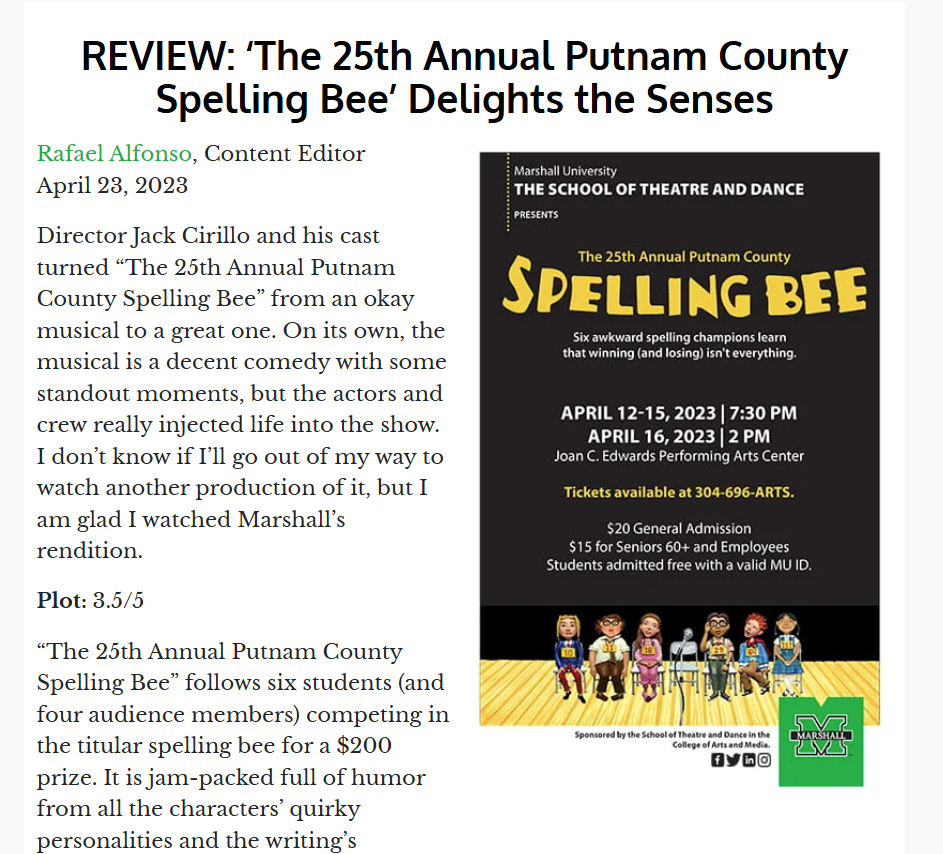
I reviewed three of the Marshall Theatre department’s shows while at The Parthenon: a contemporary play, a Shakespearean comedy, and a musical. Of them, “The 25th Annual Putnam County Spelling Bee” musical was my favorite because it gave me the opportunity to deliver fair amounts of both critique and praise.
Writing these reviews served to diversify our arts coverage, which generally amounted to reporting on when and where a gallery or performance was happening. On a more personal note, these reviews also familiarized me with some of the big names the theatre department, which was helpful when I performed with them in their production of SpongeBob: The Musical.
Event Coverage
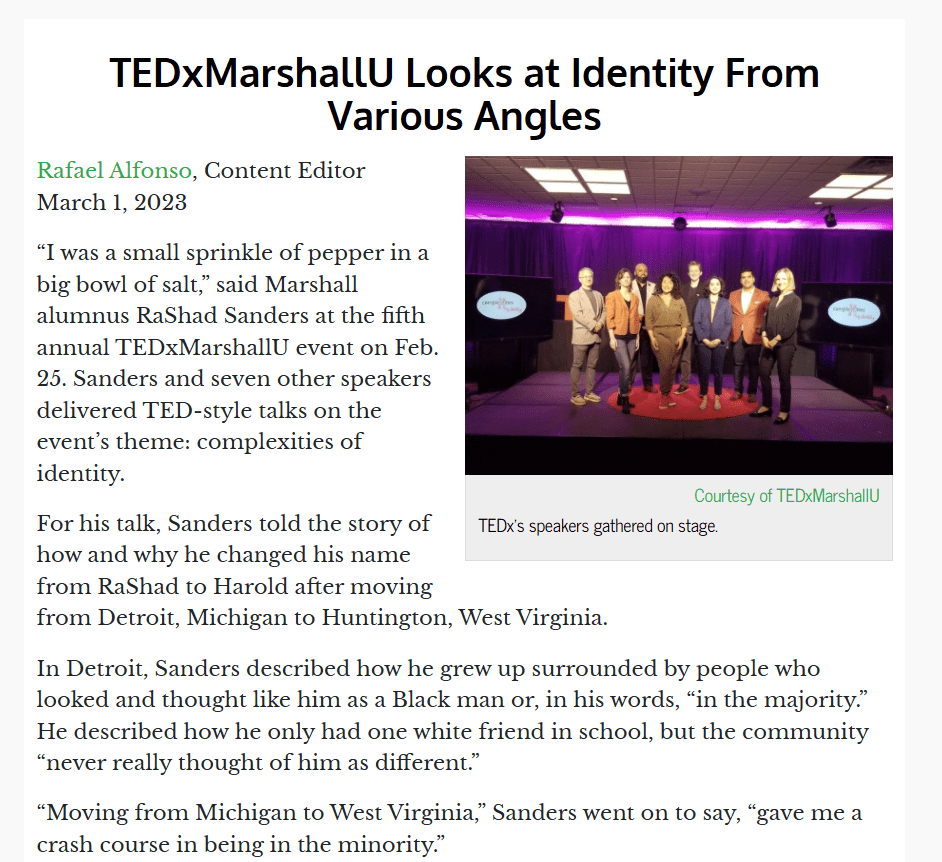
I covered a few higher profile events at Marshall, such as the Amicus Curiae lecture series and TEDxMarshallU. These events had me engage with a variety of topics, from election law to microbiology.
The article above actually caught the eye of the faculty organizer for TEDxMarshallU, and he called me a couple weeks after the event to tell me that my article was the best coverage he’d seen over the past few years. On that same phone call, he strongly encouraged me to apply to be the next Communications Director, a position that eventually allowed me to further exercise my journalistic skills.
 Rafael Alfonso Portfolio